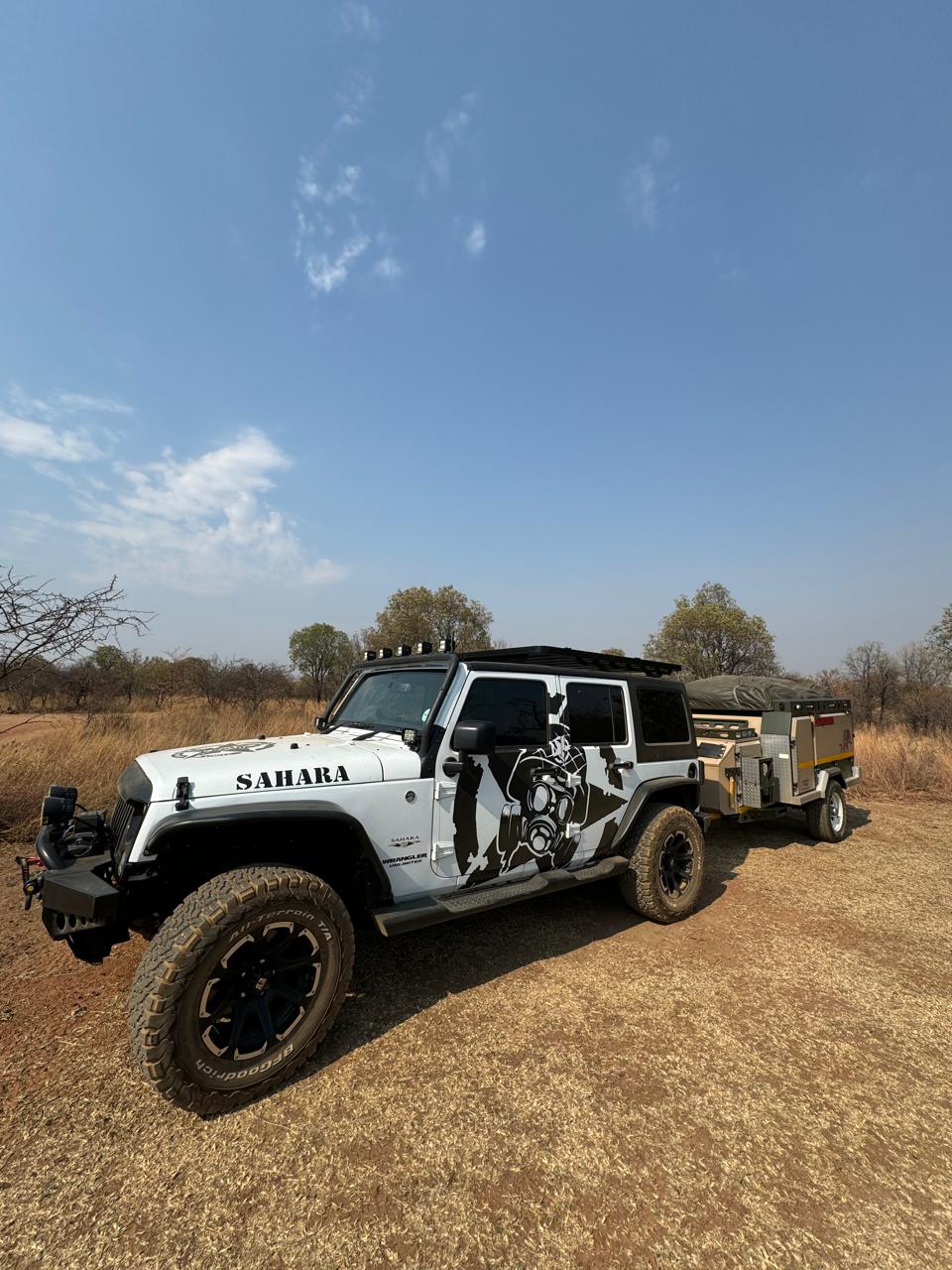
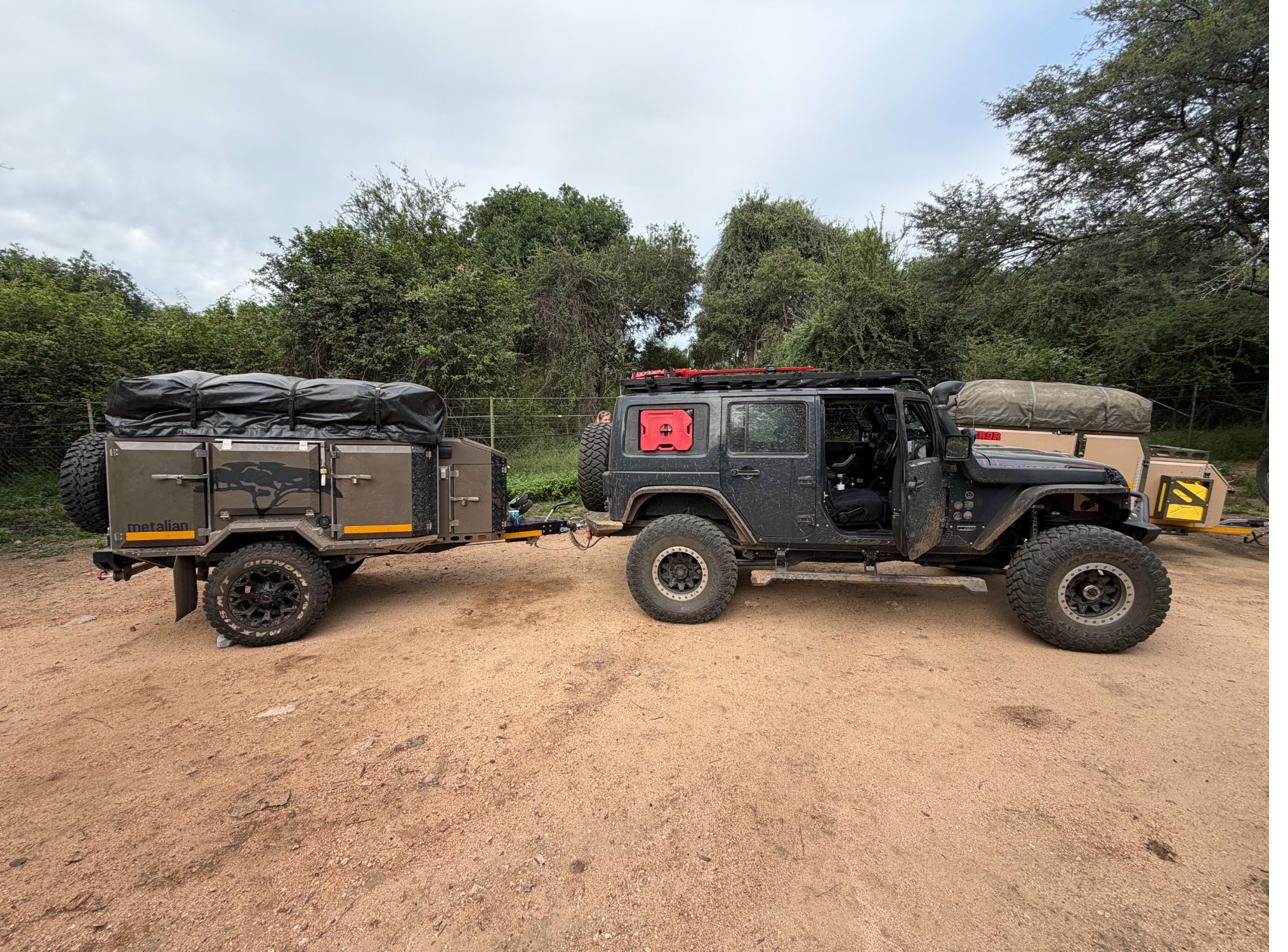
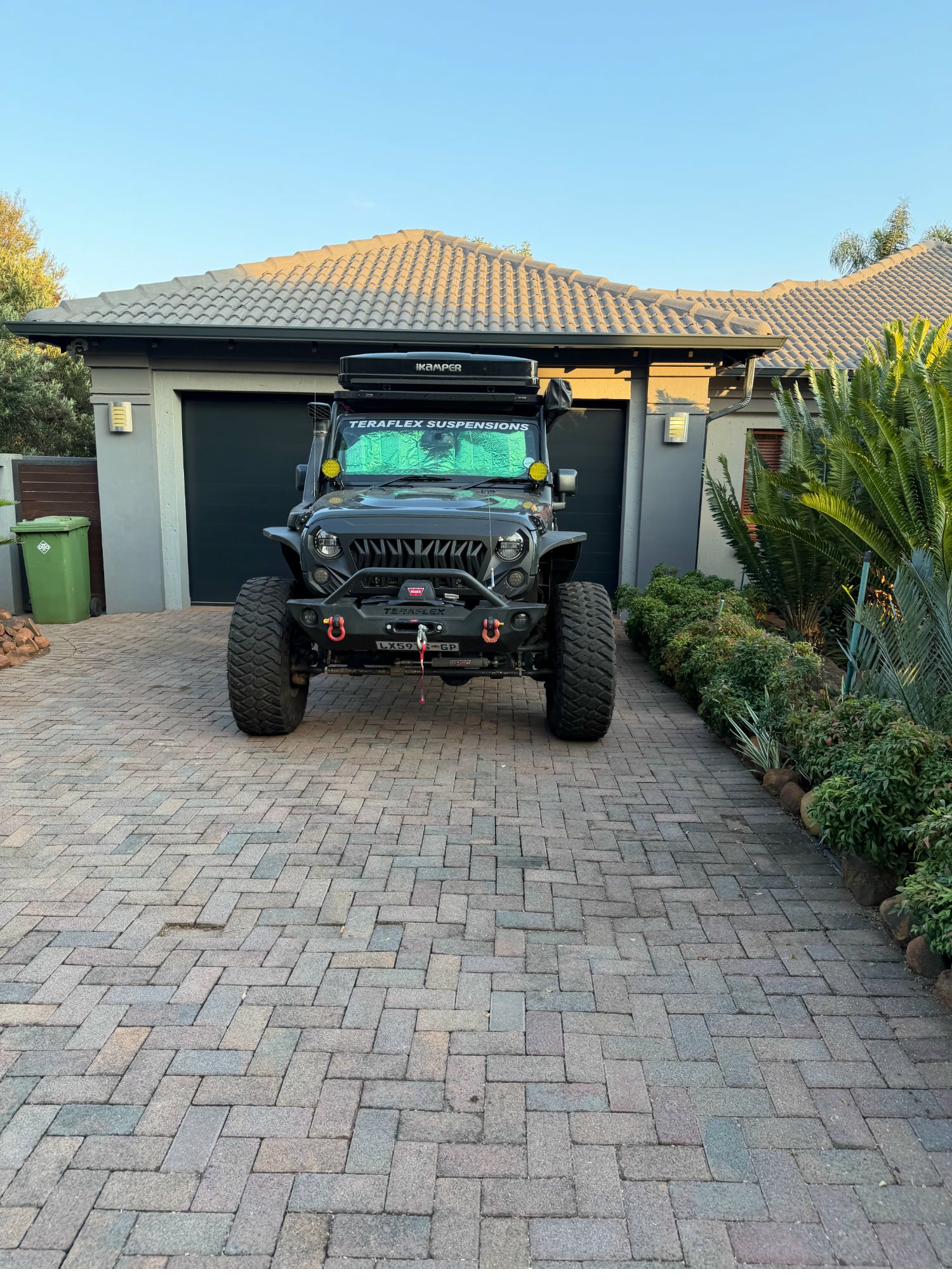
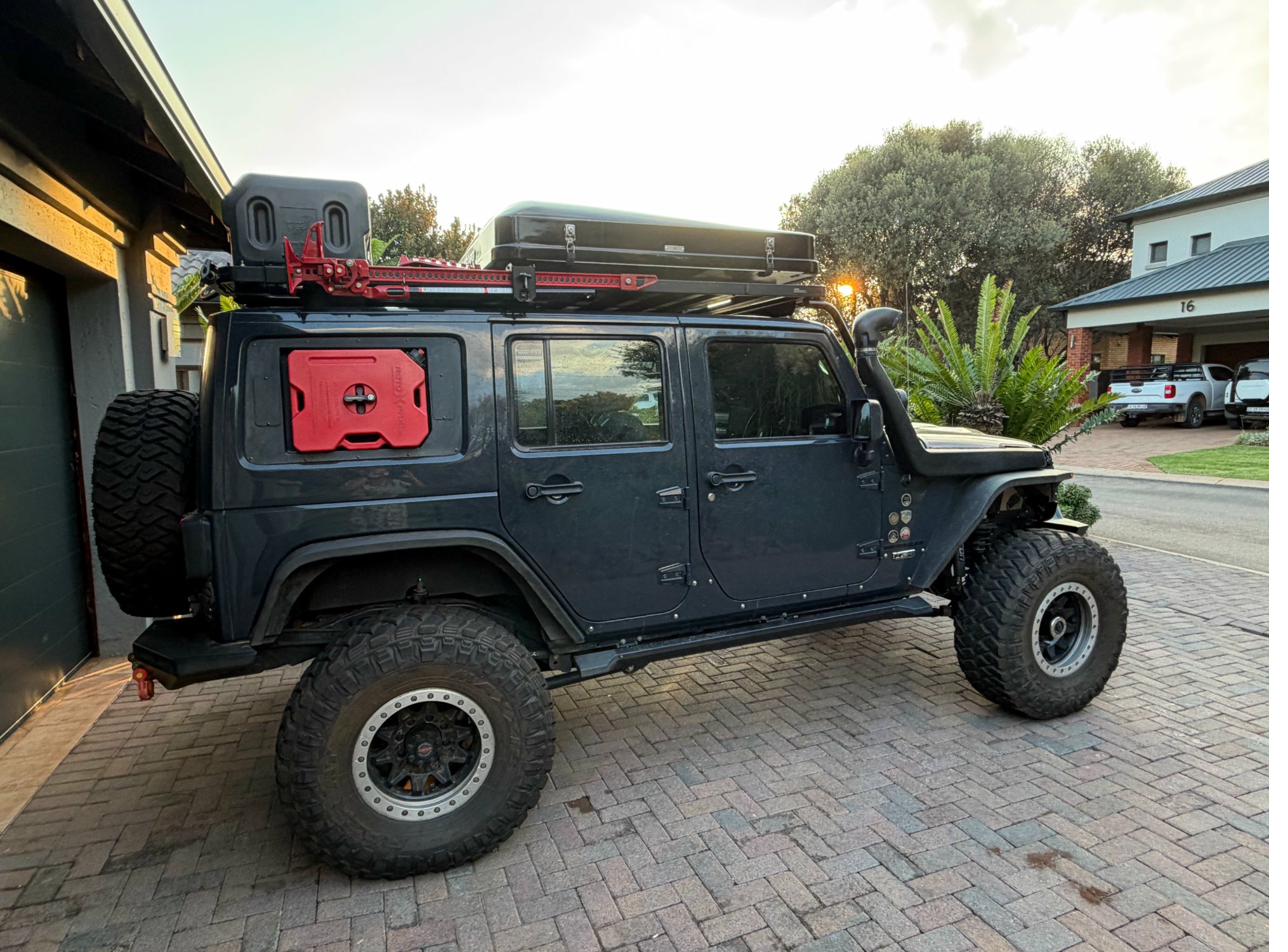
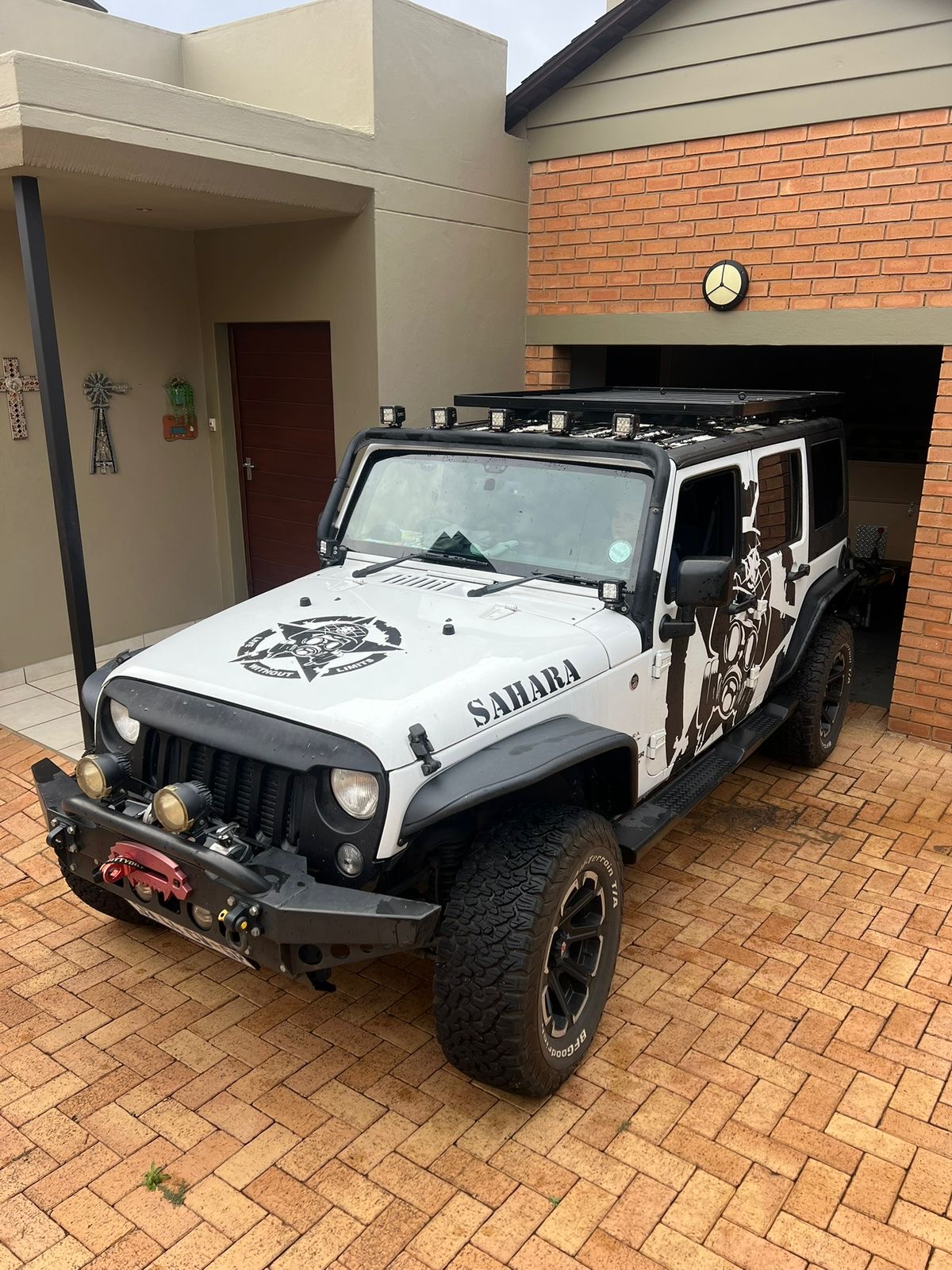
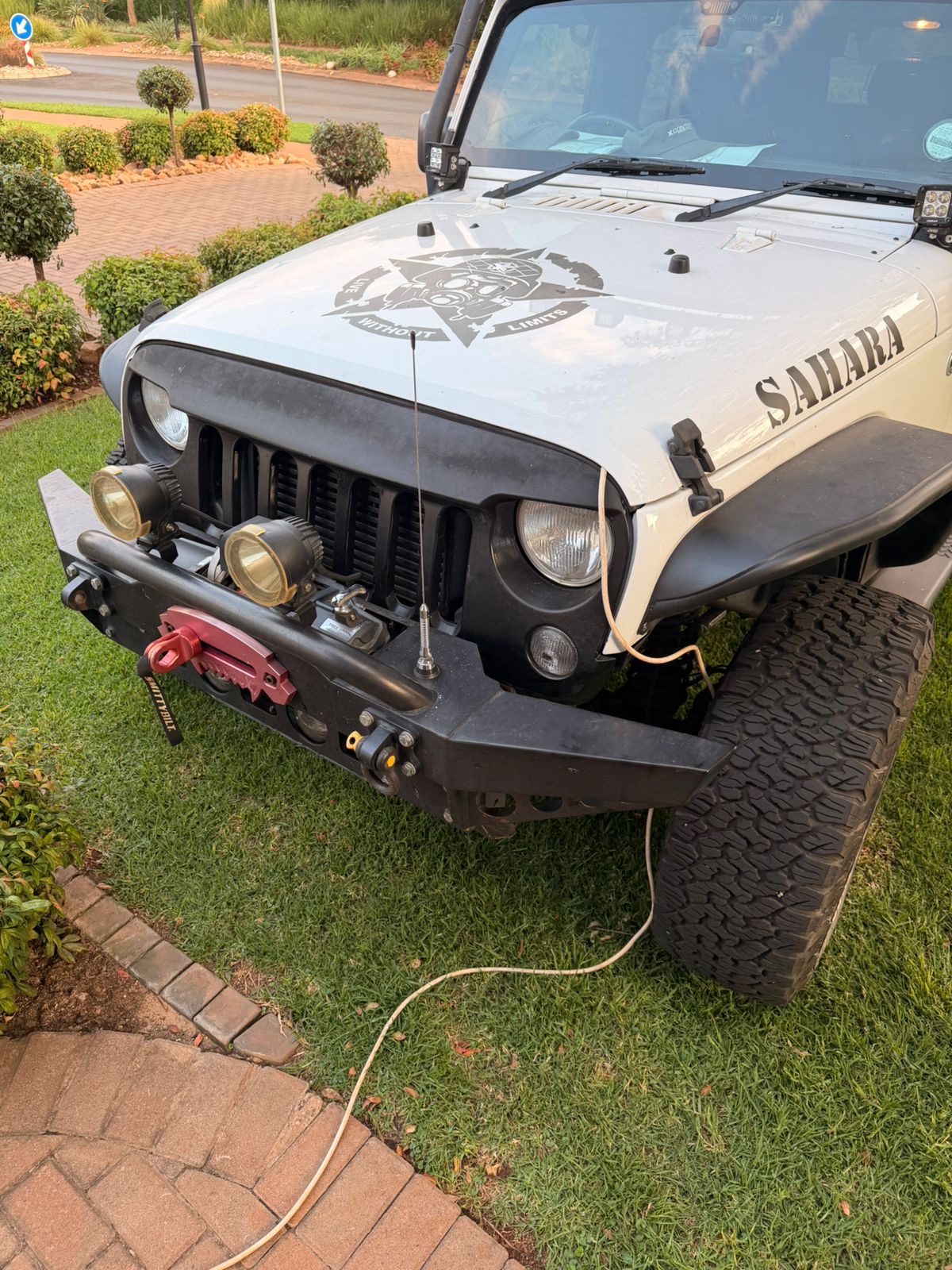
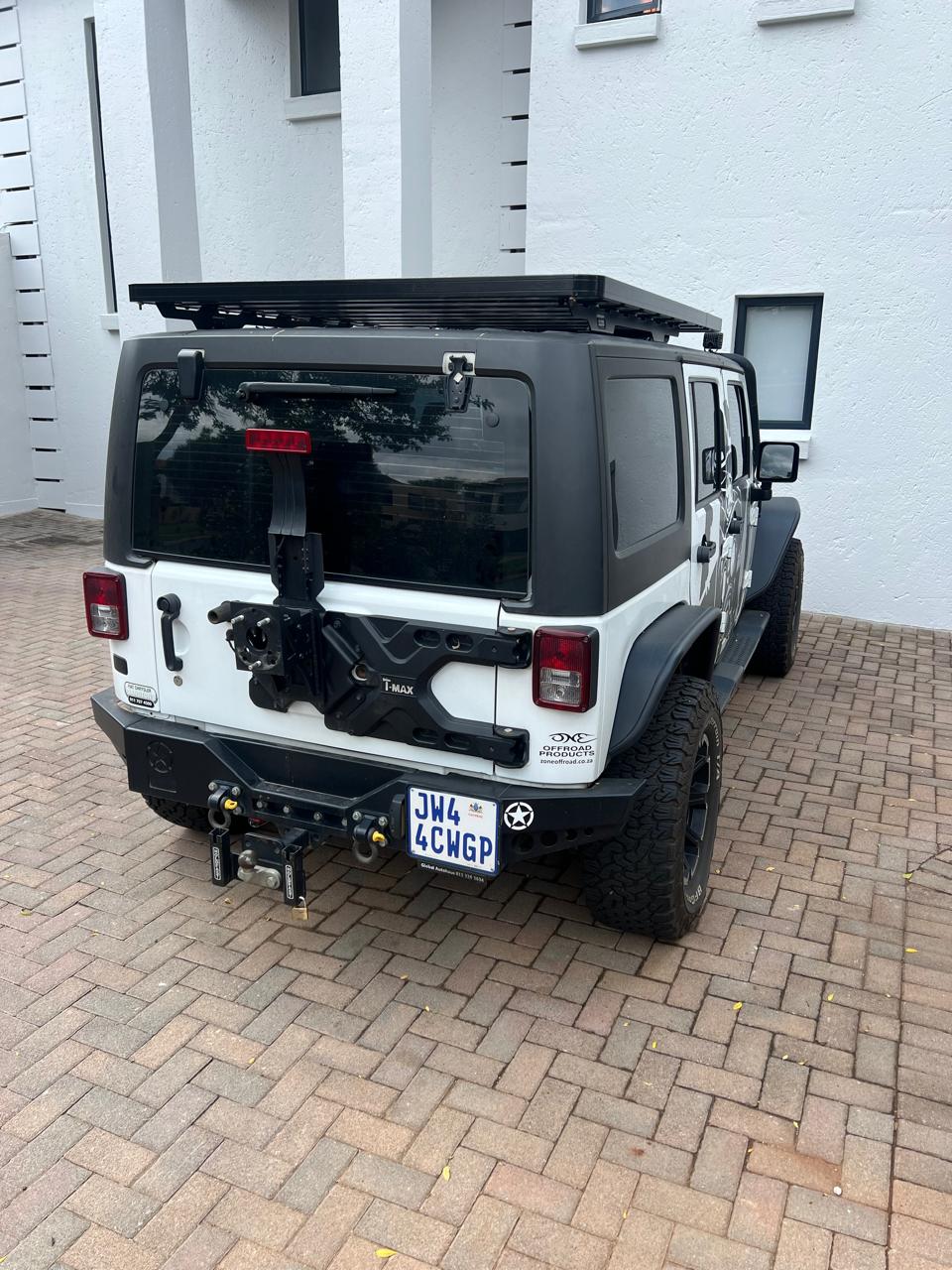
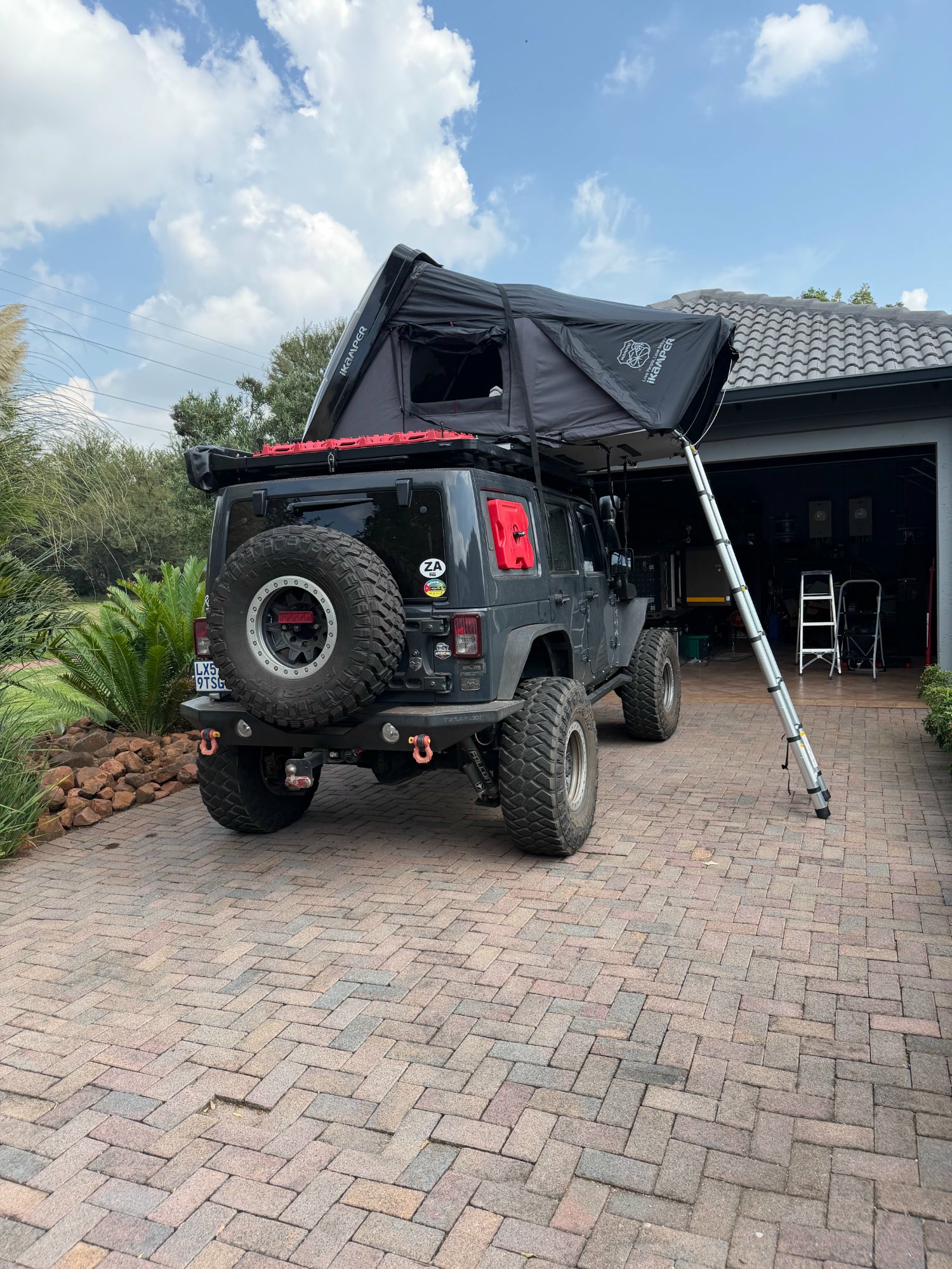
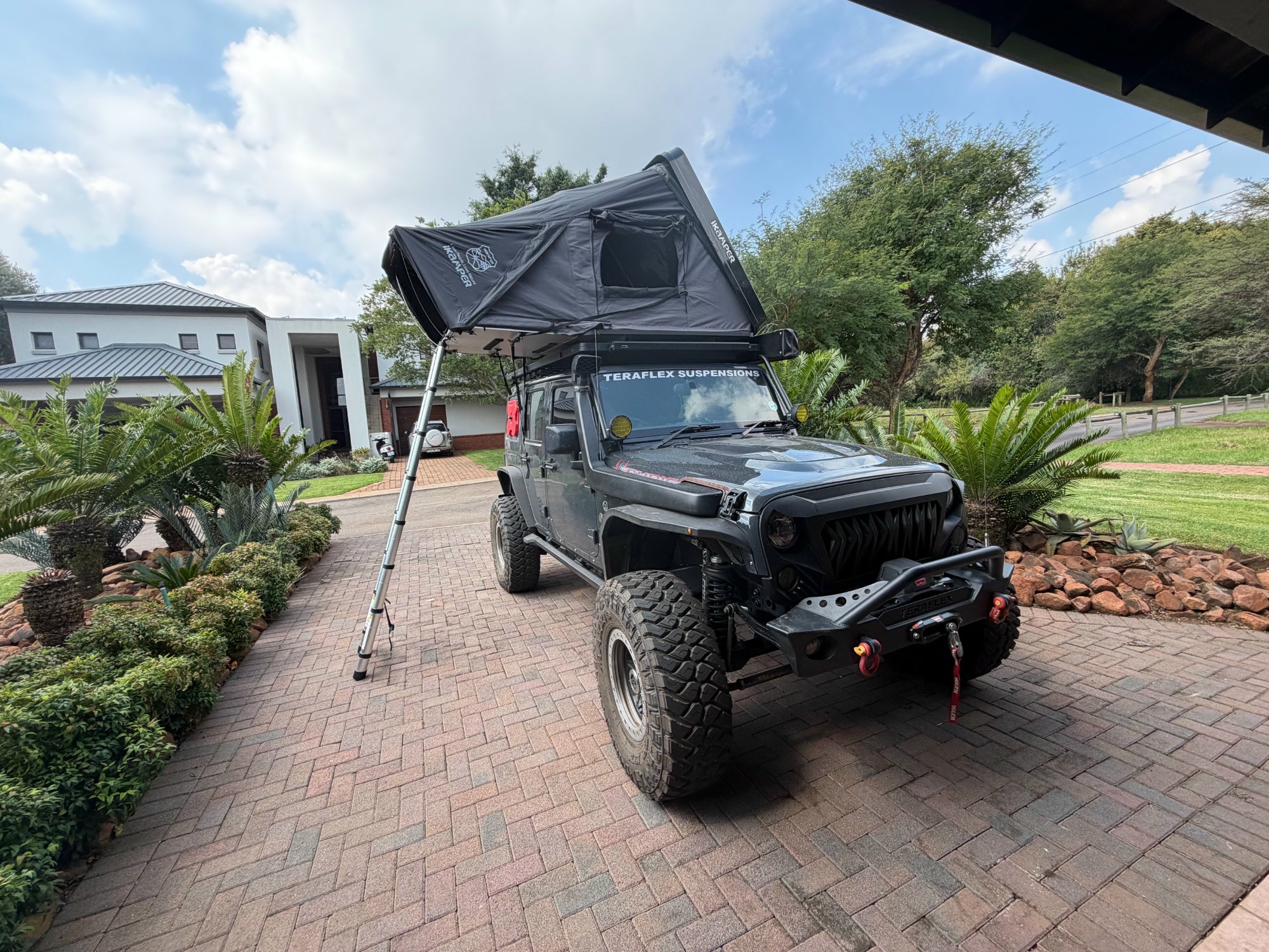
Eagle Overland operates two purpose-built Jeep Wranglers — The Beast and Julius — engineered for serious expedition travel across Southern Africa's most demanding terrain.
Each vehicle is a purpose-built expedition platform with its own character, strengths, and complete system suite — designed to operate independently or in convoy across Southern Africa.
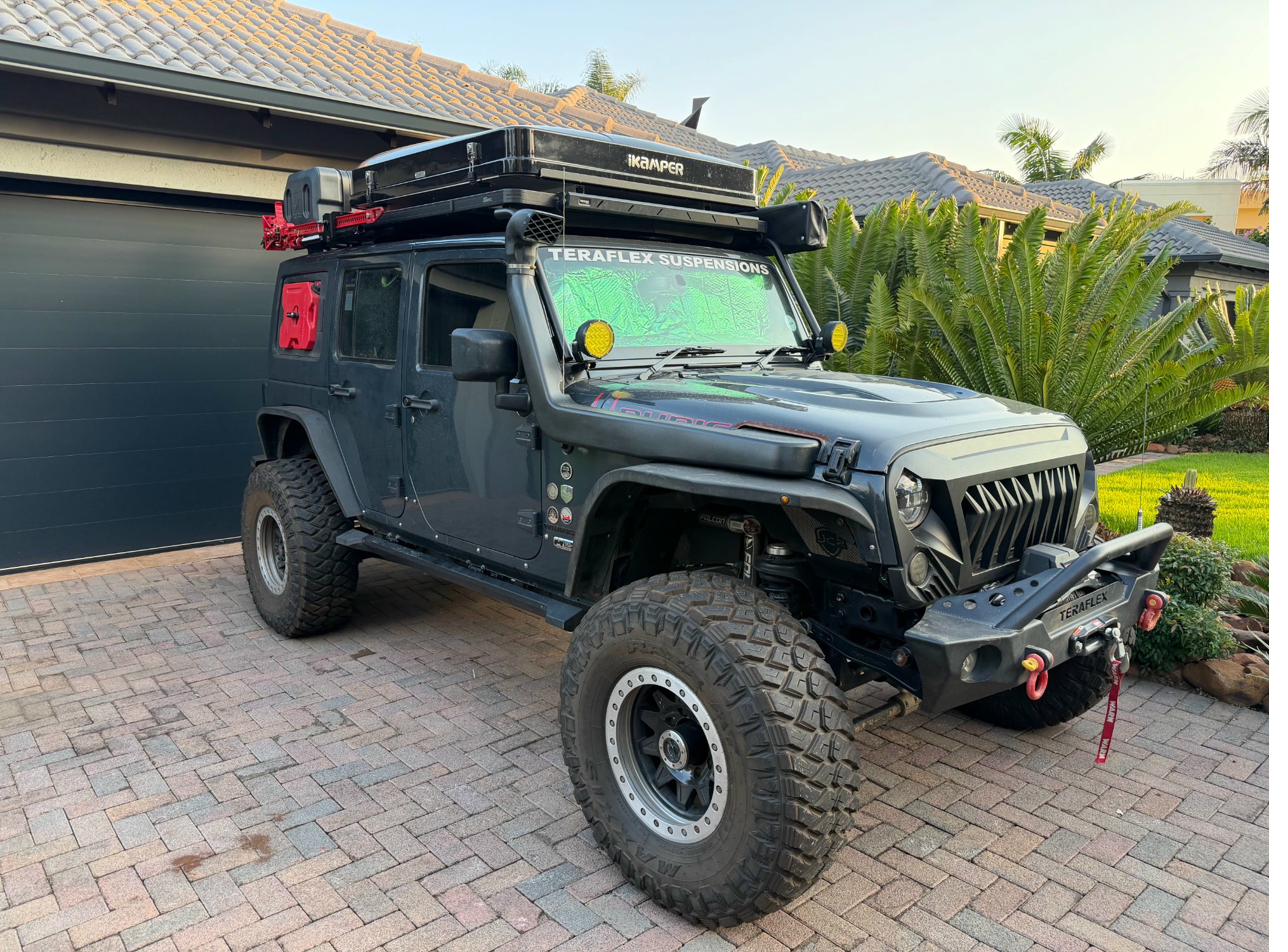
Eagle Overland operates a two-vehicle convoy model by design. The Beast — Eagle 1 — is the heavy expedition platform: fully locked, maximally specced, built for the most technical terrain Southern Africa offers. Julius — Eagle 2 — is the diesel touring vehicle: efficient, high-torque, with exceptional refrigeration and camp infrastructure for extended comfort in the field.
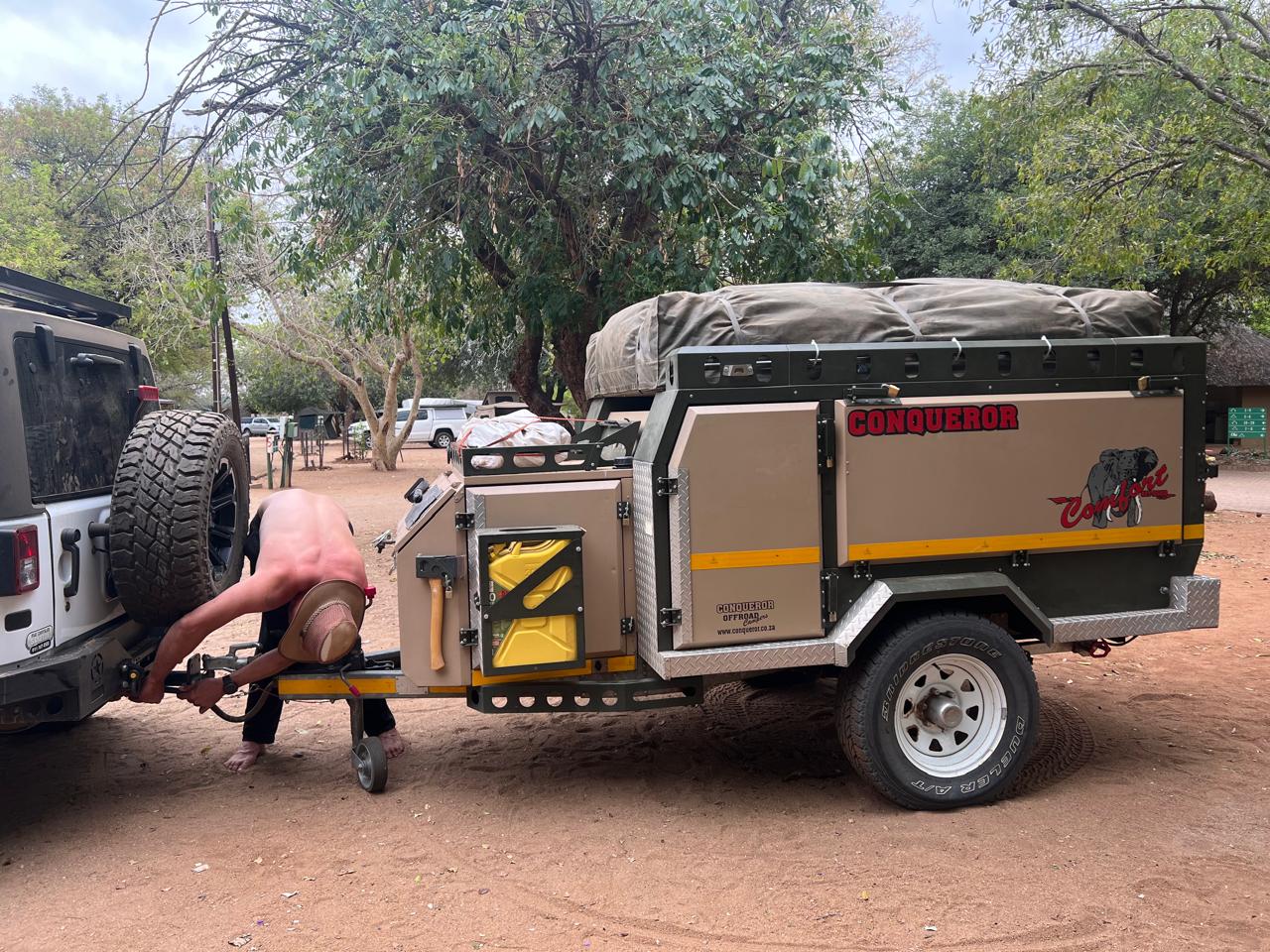
Together they form a self-sufficient convoy. Eagle 1 leads on technical sections with its ARB lockers and WARN winch. Eagle 2 carries the camp kitchen, 170L of refrigeration, and the Conqueror trailer's full living infrastructure. Both vehicles carry VHF radios for continuous convoy communication, and Eagle 1's Garmin Messenger provides satellite-level emergency coverage for the entire group.
This is expedition overlanding done properly — capability where it matters, comfort where it counts, and redundancy built into every system.
Full system-by-system assessments for both vehicles — component ratings, confirmed mechanical inspections, and detailed scoring across every build category.
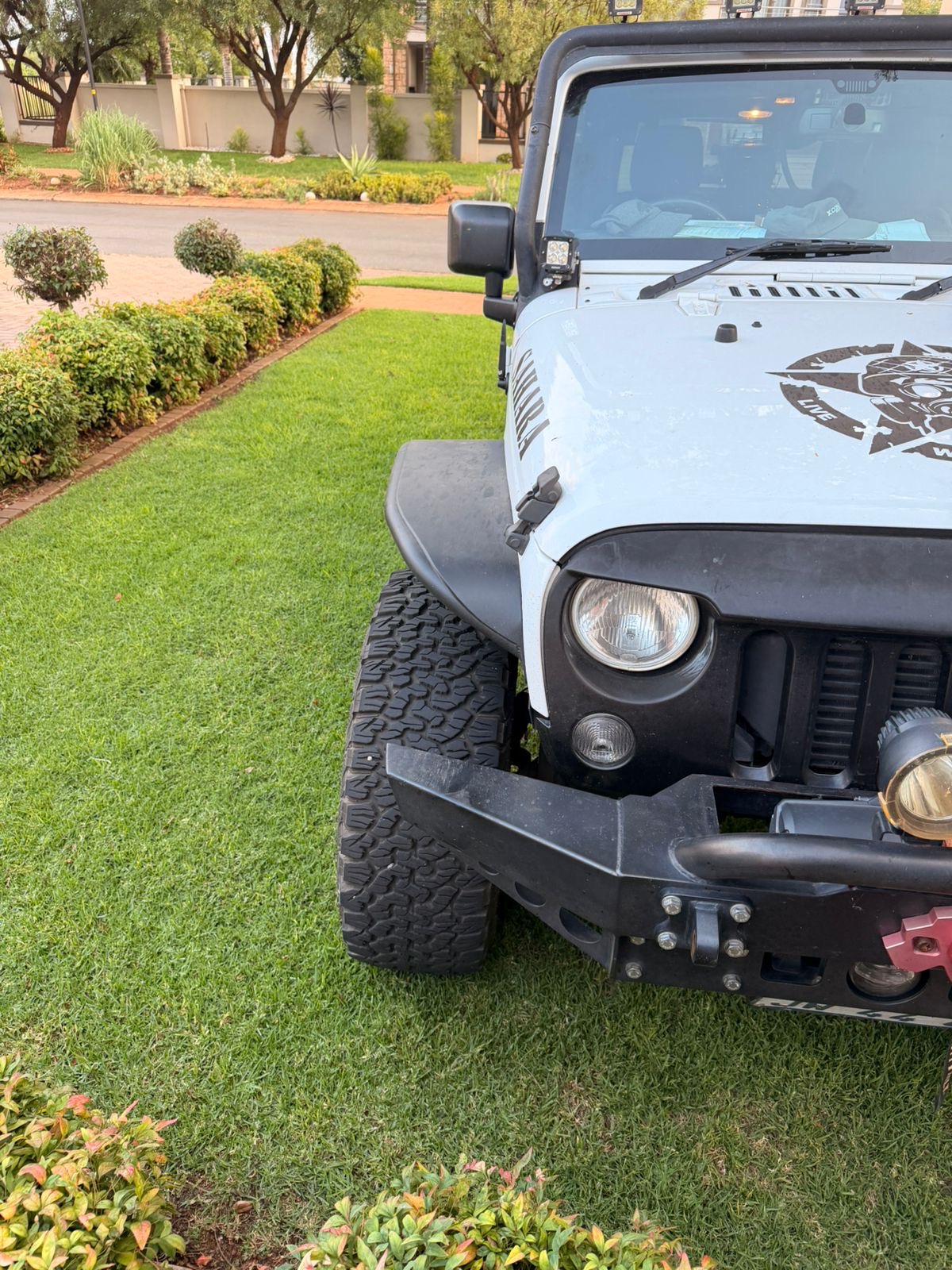
The 2015 Jeep Wrangler Sahara is powered by the 2.8L CRD (Common Rail Diesel) engine — the VM Motori unit fitted across the JK range for markets outside North America. This is a significant platform distinction from a petrol JK: the 2.8 CRD produces substantially more torque at lower RPM, giving it a commanding advantage on technical climbs, towing the Conqueror trailer through varied terrain, and maintaining efficiency on long-range highway transfers between expedition destinations.
The diesel's torque characteristics are particularly well-suited to overland use — low-speed crawling over rocks and through mud benefits directly from the engine's ability to pull cleanly from near-idle without requiring high revs. Fuel economy in overland conditions is meaningfully better than a petrol equivalent, which compounds the range advantage provided by the auxiliary jerrycans. The 2.8 CRD is a proven, robust engine in the African overland context with widespread service support across the region.
The Sahara trim provides a well-equipped factory base with Trac-Lok limited-slip rear differential, Electronic Sway Bar Disconnect, and the Command-Trac 4WD system — a solid foundation on which the TeraFlex suspension upgrades build meaningfully.
The 2.8 CRD diesel is arguably the most capable factory engine ever fitted to a JK for overland use. Its torque output, fuel efficiency, and low-RPM pulling power make it better suited to expedition towing and technical terrain than any petrol JK equivalent. This is an excellent platform choice for the intended use.
| Attribute | Specification | Rating |
|---|---|---|
| Engine | 2.8L VM Motori CRD Diesel | Excellent |
| Output | ~177 hp / 460 Nm torque | Excellent |
| Transfer Case | Command-Trac 4WD | Good |
| Rear Diff | Trac-Lok LSD | Good |
| Model Year | 2015 | Good |
A 2-inch lift has been fitted using TeraFlex control arms — specifically the TeraFlex Relocation Bracket (release arm) and TeraFlex Stability Arms. This is an important distinction: rather than a full coil-over or spring-and-shock replacement lift, this setup uses TeraFlex's geometry correction arms to improve axle articulation and stability at the modest 2-inch lift height. The relocation bracket corrects the front track bar angle at lift, eliminating the steering pull and bumpsteer that uncorrected lifted JKs typically exhibit. The stability arms correct the rear control arm geometry, ensuring predictable handling on and off road.
The vehicle runs 33-inch tyres — well-matched to the 2-inch lift with no rubbing, correct speedometer calibration range, and minimal additional stress on wheel bearings and drivetrain components compared to the 37s on Vehicle 01. The 33" size is an excellent practical choice for a Sahara-based build that will split time between trail driving and tar road transfers — it provides meaningful ground clearance improvement over stock without the fuel economy, wear, or drivetrain stress penalties of larger rubber.
The combination of TeraFlex geometry correction arms and 33" tyres represents a well-considered, balanced lift for this platform and use case. It improves off-road capability substantially without over-modifying a vehicle that retains strong on-road manners.
A 2-inch geometry-corrected TeraFlex lift on 33" tyres is a smart, balanced choice for this vehicle. It delivers real off-road improvement without the complexity, cost, or on-road compromise of a larger lift. The TeraFlex arms address the JK's known geometry issues at lift height, giving this vehicle predictable and reliable handling in all conditions.
The 85/100 score for this section reflects the absence of front and rear diff lockers — the single most impactful traction upgrade not yet present on this build. See the Path to Full Score section at the end of this report.
| Component | Specification | Rating | Notes |
|---|---|---|---|
| Lift Height | 2 inches | Good | Well-matched to 33" tyre fitment |
| Front Geometry | TeraFlex Release Arm / Track Bar Relocation | Excellent | Corrects bumpsteer and pull at lift height |
| Rear Geometry | TeraFlex Stability Arms | Excellent | Correct rear control arm angle at lift |
| Tyre Size | 33" — All-Terrain or Mud-Terrain | Good | Practical choice — minimal drivetrain stress |
| Diff Lockers | Not fitted — Trac-Lok LSD rear only | Recommended Upgrade | ARB Air Lockers F&R would significantly elevate capability |
The vehicle is equipped with a 12,000 lb winch with synthetic rope — synthetic rope is the correct specification over wire cable for overland use. Synthetic rope is safer when it parts under load (no dangerous recoil), lighter, easier to handle, and does not develop the dangerous metal burrs that wire cable accumulates over time. The 12,000 lb rating appropriately exceeds the vehicle's gross vehicle weight, providing adequate mechanical advantage for self-recovery and assisting the trailer if required. A full recovery kit accompanies the winch, and MAXTRAX traction boards are carried — providing the primary first-response recovery tool for sand, mud, and loose terrain before the winch is deployed. A mobile air compressor capable of inflating the 33" tyres is carried, enabling tyre pressure management for all off-road conditions and post-recovery re-inflation. Spot lights are fitted on the roof rack and on the A-frame for night bush driving capability.
| Item | Specification | Rating | Notes |
|---|---|---|---|
| Winch | 12,000 lb — Synthetic Rope | Excellent | Synthetic rope — correct spec; safer than wire cable |
| Recovery Kit | Full Kit — vehicle carried | Excellent | Snatch strap, shackles, tree trunk protector assumed |
| MAXTRAX | Traction Boards — carried | Excellent | First-response sand and mud recovery |
| Air Compressor | Mobile — 33" Tyre Capable | Good | Tyre inflation and pressure management off-road |
| Spot Lights — Roof | Mounted on Front Runner half rack | Good | Forward illumination for night bush driving |
| Spot Lights — A-frame | Mounted on A-frame | Good | Low-level forward fill lighting |
| Half Roof Rack | Front Runner — Half Rack | Good | Mounting platform for lights, jerrycans, and gear |
The vehicle carries a LiFePO4 108Ah secondary battery managed by a DC-DC charger and supplemented by a solar panel — confirmed and correctly specified. This 108Ah LiFePO4 bank provides approximately 103Ah of usable power (95% DoD), powering the National Luna 80L fridge/freezer, 12V outlets, lighting, and radios without touching the starting battery.
The Conqueror off-road trailer carries a more substantial electrical system: 2 × 10⁸Ah LiFePO4 batteries (216Ah total), managed by a DC-DC charger, an MPPT solar charge controller (the correct controller type for LiFePO4 chemistry — maximum power point tracking maximises solar harvest efficiency), and shore power input for charging when at a lodge, campsite, or home base. The shore power capability is a practical addition that ensures the trailer bank arrives fully charged at the start of any expedition regardless of solar conditions in the preceding days.
The trailer's MPPT controller is the technically superior choice over a PWM controller — it extracts maximum energy from the solar panel across all light conditions, which is particularly valuable in the variable sun angles and partial shade conditions encountered in bush camping environments.
The trailer's three-source charging system — DC-DC from the vehicle alternator while driving, MPPT solar while stationary, and shore power at camp — means the 216Ah LiFePO4 bank is replenished from every available source simultaneously. This is the most comprehensively charged trailer battery system possible.
LiFePO4 108Ah confirmed in the vehicle, with MPPT solar control and triple-source shore power on the trailer — this is a correctly engineered electrical system end to end. Battery shunt monitors on both banks would complete the documentation and close the remaining gap to a full score on this section.
| System | Specification | Rating | Notes |
|---|---|---|---|
| Vehicle Aux Battery | LiFePO4 108Ah — confirmed | Excellent | ~103Ah usable (95% DoD) — DC-DC + solar charged |
| Vehicle Charge Source | DC-DC Charger + Solar | Excellent | Correct dual-source charging |
| Trailer Battery Bank | 2 × LiFePO4 108Ah (216Ah total) | Excellent | ~205Ah usable at 95% DoD |
| Trailer — DC-DC | DC-DC Charger — installed | Excellent | Charges trailer bank from vehicle alternator |
| Trailer — Solar | MPPT Charge Controller | Excellent | Correct controller for LiFePO4 — max harvest efficiency |
| Trailer — Shore Power | Mains input — installed | Excellent | Full charge from campsite / home before departure |
| Fridge — Vehicle | National Luna 80L Fridge/Freezer | Excellent | Premium SA brand — proven reliability in field |
| Fridge — Trailer | National Luna 90L Fridge/Freezer | Excellent | Dedicated trailer unit — independent of vehicle power |
| Battery Monitoring | Shunt — confirm installed on both banks | Confirm | Real-time SoC monitoring recommended on both units |
The Conqueror off-road trailer is one of Southern Africa's most respected expedition trailer brands, purpose-built for the terrain and conditions this vehicle will encounter. The Conqueror provides a complete, self-contained camp platform — carrying the LiFePO4 battery bank, the National Luna 90L fridge/freezer, the camp kitchen infrastructure, and the shelter system.
The trailer is equipped with a rooftop tent (RTT) and annex — the RTT providing elevated, fast-deploy sleeping above ground level (essential in game areas), and the annex creating a sheltered living and cooking space attached to the tent. This transforms camp from a simple overnight stop into a comfortable, weatherproof extended living environment suitable for multi-week expeditions.
Two 5kg gas bottles are mounted on the trailer, providing the cooking fuel system. Gas is the correct cooking solution for an overland trailer of this specification — reliable ignition in wet conditions, easily controlled heat for cooking, and the 2 × 5kg supply provides substantial duration for extended trips. Gas cylinder availability for refill is good across Southern Africa's main overland routes.
The vehicle carries a Front Runner half roof rack providing a mounting platform for the spot lights, jerrycans, and gear without the full weight penalty of a complete rack. Two 20-litre jerrycans provide 40 litres of auxiliary diesel — extending range on remote routes where diesel availability is uncertain.
The Conqueror trailer with RTT, annex, dual gas bottles, National Luna 90L fridge, and the full LiFePO4 / MPPT / shore power electrical system is a complete, capable expedition camp platform. Paired with the National Luna 80L in the vehicle and the dual jerrycans for range, this setup is ready for extended Southern African expedition travel without fixed accommodation.
| System | Specification | Rating | Notes |
|---|---|---|---|
| Expedition Trailer | Conqueror Off-Road Trailer | Excellent | SA-built, expedition-rated, proven platform |
| Shelter | RTT — Rooftop Tent | Excellent | Elevated sleeping — game area appropriate |
| Annex | Full Annex — attached to RTT | Excellent | Sheltered living and cooking space |
| Gas System | 2 × 5kg Gas Bottles — trailer mounted | Excellent | Reliable cooking fuel — good SA refill availability |
| Fridge — Trailer | National Luna 90L Fridge/Freezer | Excellent | Industry-leading SA brand — field proven |
| Fridge — Vehicle | National Luna 80L Fridge/Freezer | Excellent | 170L total refrigeration across vehicle and trailer |
| Half Roof Rack | Front Runner — Half Rack | Good | Light, strong mounting platform |
| Auxiliary Fuel | 2 × 20L Jerrycans — Diesel | Good | 40L reserve — range extension on remote routes |
The vehicle carries a vehicle-mounted VHF mobile radio and a VHF handheld radio — the same two-unit architecture as Vehicle 01, providing both in-vehicle comms and personal radio coverage when crew depart the vehicle on foot. VHF is the correct and essential communications tool for Southern African game reserve operation, convoy coordination, and emergency contact in areas beyond cellular coverage. The dual-unit setup ensures radio contact is never lost regardless of whether the occupants are in or out of the vehicle.
| System | Specification | Rating | Notes |
|---|---|---|---|
| VHF Radio — Vehicle | Mobile unit — vehicle mounted | Excellent | Primary comms — reserve, convoy, emergency |
| VHF Radio — Handheld | Portable unit — carried on person | Excellent | Comms when crew departs vehicle on foot |
| Satellite Comms | Not confirmed on this vehicle | Recommended | Garmin Messenger or inReach would add global SOS layer |
| Dedicated GPS Nav | Not confirmed on this vehicle | Recommended | Dedicated overland GPS unit recommended for remote routing |
A well-equipped, diesel-powered overland touring platform with a complete camp system and strong electrical foundation. Clear path to a higher score.
The 2015 Jeep Wrangler Sahara 2.8 CRD is a capable, well-considered overland touring build with several standout features — most notably the 2.8L diesel engine for torque and efficiency, the Conqueror trailer with its triple-source LiFePO4 charging system, 170L of National Luna refrigeration across vehicle and trailer, and the dual VHF radio setup. The TeraFlex geometry-corrected suspension is correctly specified for the 33" tyre fitment. The primary gap versus Vehicle 01 is the absence of differential lockers — ARB Air Lockers front and rear would be the single most impactful upgrade available to this build, transforming its technical off-road traction to match its otherwise strong specification. With the recommended upgrades completed, this vehicle has a clear path to a score in the 97–99 range. Current classification: TRAIL READY. Current score: 91 / 100.
The foundation is a Jeep Wrangler JK Unlimited 4-door — the benchmark platform for serious Southern African overland expedition builds. Solid Dana front and rear axles, the Command-Trac part-time 4WD transfer case, and a body-on-frame construction that tolerates extreme modification loads make the JK Unlimited uniquely suited to the complete build specification applied here.
Finished in matte or satin black with tactical armour cladding, the vehicle presents a cohesive, purposeful aesthetic that reflects its intended use environment. South African Gauteng registration (LX59__GP) is confirmed in the front-facing photograph. All four doors are intact, and the full hard-top roof provides structural rigidity for the iKamper and roof rack system loads above.
The vehicle shows honest working wear consistent with regular use in bush and gravel environments. This is the correct condition for a vehicle of this specification — a showpiece build would be a concern; a well-used one is the point.

| Attribute | Specification | Rating | Notes |
|---|---|---|---|
| Platform | Jeep Wrangler JK Unlimited | Excellent | Industry-standard expedition base platform |
| Body | 4-Door Full Hard-Top | Excellent | Structural integrity for heavy roof loads |
| Axles | Dana Solid Front & Rear | Excellent | Superior articulation; ARB Locker compatible |
| Exterior Condition | Matte Black — Armour Cladding | Good | Working trail wear present — expected |
| Registration | South Africa — Gauteng | Confirmed | LX59__GP visible in photographs |

A TeraFlex suspension lift system — confirmed by the windscreen banner — has been installed to approximately 4–4.5 inches of lift. TeraFlex manufactures geometry-corrected systems engineered specifically for the JK platform, correcting caster angle and control arm positioning to maintain handling stability and tyre wear within acceptable ranges at lifted heights.
The lift accommodates 37-inch Mud-Terrain tyres on matte black beadlock rims. Beadlock wheels are a critical inclusion — they allow tyres to be aired down to very low pressures for sand, rock, and mud traction without risk of the tyre bead separating from the rim. This is the correct wheel specification for the use case this vehicle is built for.
Estimated ground clearance with this combination exceeds 330 mm, representing a substantial improvement over a stock JK. Combined with the ARB Air Lockers (see Section 03), this suspension configuration transforms the vehicle's technical off-road capability entirely.
A mature and correctly specified suspension build. TeraFlex on 37" MT beadlocks is a proven, professional expedition configuration. Long-term reliability is maintained through the geometry corrections inherent in the TeraFlex system — this is not a rough cut-and-shim lift.
| Component | Specification | Rating | Notes |
|---|---|---|---|
| Lift System | TeraFlex ~4.5" — Geometry Corrected | Excellent | Leading JK suspension brand; caster correction included |
| Tyres | 37" Mud-Terrain | Excellent | Maximum fitment for 4.5" lift |
| Wheels | Beadlock Rims — Matte Black | Excellent | Essential for aired-down use; correct specification |
| Geometry Correction | Caster — included in kit | Excellent | Road stability maintained at lift height |
| Ground Clearance Est. | 330 mm+ | Excellent | Significant over-stock improvement |
This vehicle is fitted with ARB Air Lockers on both the front and rear differentials — the single most impactful drivetrain upgrade available on any 4WD platform. ARB Air Lockers replace the differential's spider gears with a solid pneumatic lock, forcing both wheels on each axle to rotate at precisely the same speed regardless of traction conditions. The result is 100% torque delivery to all four corners simultaneously when required.
This is a true positive lock, not a limited-slip differential — there is no torque bias percentage, no ramp angle, no slip threshold. When engaged, the axle is locked. On rock crawls where diagonal wheel lift would otherwise stop a standard JK in its tracks, on deep mud where one wheel has zero traction, or on steep climbs where a standard diff would simply spin the wheel with less grip — the ARB locks engage on-demand and eliminate the problem entirely.
The lockers are actuated by the ARB Twin Air Compressor mounted onboard, powered from the dual battery system. This is the correct pairing — the twin compressor provides fast, reliable actuation pressure for both lockers and doubles as a tyre inflation station after airing down for off-road sections, removing the need for any external pump.
The decision to fit lockers on both axles — not just the rear as is common on less committed builds — marks this as a vehicle prepared for genuinely extreme terrain. Front and rear locks together deliver a fundamentally different level of capability versus a rear-only setup.
ARB Air Lockers front and rear represent the definitive traction upgrade for this platform. The investment in both axles — not just the rear — reflects a builder who has driven technical terrain and understands why the front locker matters. Paired with the onboard ARB Twin Compressor, this is a self-contained traction and tyre management system that gives this vehicle a decisive advantage over every unlocked JK it will encounter in the field.
| Component | Status | Rating |
|---|---|---|
| Front ARB Locker | Installed — engagement confirmed | Excellent |
| Rear ARB Locker | Installed — engagement confirmed | Excellent |
| ARB Twin Compressor | Onboard — pressure output confirmed | Excellent |
| Locker Airlines | Pressure tested — no leaks | Confirmed |
| Transfer Case | Command-Trac — fluid confirmed | Confirmed |
| CV Boots | Inspected — serviceable | Confirmed |
The recovery package is comprehensive and professionally specified. The WARN 12,000 lb winch on the TeraFlex front steel bumper is the primary self-recovery tool — providing the mechanical advantage to extract the vehicle from any stuck scenario or assist a second vehicle. Factor 55 shackles in red (front) and orange (rear) provide high-rated, purpose-built recovery points that exceed the vehicle's gross vehicle weight. The custom armour plating protects underbody and lower body panels on technical trails. The ARB Twin Compressor additionally serves the recovery role as a tyre inflation station after airing down.
| Item | Specification | Rating | Purpose |
|---|---|---|---|
| Front Winch | WARN 12,000 lb | Excellent | Self-recovery and vehicle assist |
| Front Bumper | TeraFlex Steel w/ Winch Mount | Excellent | Winch platform, approach angle, protection |
| Rear Bumper | Heavy-Duty Aftermarket | Excellent | Departure angle and rear recovery points |
| Recovery Points (F) | Factor 55 — Red | Excellent | High-rated forward recovery anchor |
| Recovery Points (R) | Factor 55 — Orange | Excellent | High-rated rear recovery anchor |
| Body Armour | Custom Steel Panels | Good | Rock, stump, and brush protection |
| Tyre Inflation | ARB Twin Compressor (onboard) | Excellent | Re-inflate after airing down — no external pump needed |
The electrical system on this build is built around Lithium Iron Phosphate (LiFePO4) battery chemistry — a significant step above the lead-acid or AGM deep-cycle batteries found in most overland builds. LiFePO4 chemistry delivers approximately 95% usable capacity versus 50% for AGM, charges three to four times faster, tolerates thousands of charge cycles without meaningful capacity degradation, and is substantially lighter per amp-hour. The choice of LiFePO4 throughout reflects serious long-term thinking about the electrical architecture.
The vehicle carries a LiFePO4 236Ah auxiliary battery managed by a DC-DC charger set to the correct LiFePO4 charge profile. This 236Ah LiFePO4 bank provides approximately 224Ah of genuinely usable power (95% DoD), equivalent to a 450Ah AGM bank in real-world terms. It powers the ARB twin compressor, LED light bar, pressurised water pump, VHF radio, fridge, Garmin devices, and all 12V outlets — simultaneously and overnight — without touching the starting battery.
The Metalian expedition trailer carries two LiFePO4 158Ah batteries — a 316Ah trailer bank — providing an enormous independent power reserve at camp. 316Ah of LiFePO4 at 95% DoD gives approximately 300Ah of usable capacity, sufficient to run a full camp — fridge, lighting, water pump, charging — for multiple days without solar input, and essentially indefinitely when the trailer solar panel is active. The trailer bank is entirely independent of the vehicle system, meaning both can be used simultaneously or the trailer can power camp while the vehicle engine is not running.
Both systems are supplemented by 230W solar panels — one on the vehicle roof and one on the trailer — providing substantial daytime charge replenishment. At 230W each, and with LiFePO4's high charge acceptance rate, both banks charge rapidly during daylight hours. In full Southern African sun a single 230W panel can deliver 50–80Ah of charge per day, meaning the vehicle's 236Ah bank can be substantially replenished from solar alone on any stationary camp day, and the trailer's 316Ah bank similarly sustained by its own panel.
Lighting is fully upgraded: a full-width LED light bar at the roofline leading edge, two yellow-lens A-pillar auxiliary driving lights for dust and fog penetration, and aftermarket LED/projector headlights replacing the factory halogens.
Total LiFePO4 capacity across vehicle and trailer: 552Ah (236 + 316). Usable at 95% DoD: approximately 524Ah. Two 230W solar panels continuously replenish both banks during daylight. This is a power system capable of sustaining a full expedition camp — fridge, lighting, water, charging — indefinitely off-grid under normal Southern African solar conditions.
LiFePO4 chemistry throughout — vehicle and trailer — is the gold standard for overland electrical systems. The combination of 236Ah in the vehicle and 316Ah in the trailer gives this build 552Ah of LiFePO4 — an electrical capacity and reliability profile that exceeds most dedicated expedition setups. Paired with two 230W solar panels and properly configured DC-DC chargers, this system will reliably support every load this vehicle carries with significant reserve margin.
| System | Specification | Rating | Notes |
|---|---|---|---|
| Starting Battery | OEM Factory — isolated | Good | Dedicated to vehicle start only — never touched by house loads |
| Vehicle Aux Battery | LiFePO4 236Ah | Excellent | ~224Ah usable (95% DoD) — equiv. to 450Ah AGM |
| Charge Management — Vehicle | DC-DC Charger — LiFePO4 Profile ✓ | Confirmed | Correct profile confirmed — 14.4–14.6V absorption |
| Trailer Battery 1 | LiFePO4 158Ah | Excellent | Independent trailer power bank — first unit |
| Trailer Battery 2 | LiFePO4 158Ah | Excellent | Independent trailer power bank — second unit |
| Total Trailer Capacity | 316Ah LiFePO4 (~300Ah usable) | Excellent | Camp fridge, lighting, water, charging — multi-day off-grid |
| Charge Management — Trailer | DC-DC Charger — LiFePO4 Profile ✓ | Confirmed | Correct profile confirmed — LiFePO4 charge curve |
| Solar — Vehicle | 230W Panel — Roof Mounted ✓ | Confirmed | ~50–80Ah/day in SA sun — vehicle bank top-up |
| Solar — Trailer | 230W Panel — Trailer Mounted ✓ | Confirmed | ~50–80Ah/day in SA sun — trailer bank top-up |
| Battery Shunt — Vehicle | Installed & Operational ✓ | Confirmed | Real-time SoC, voltage, current, runtime — 236Ah bank |
| Battery Shunt — Trailer | Installed & Operational ✓ | Confirmed | Real-time SoC, voltage, current, runtime — 316Ah bank |
| Total System Capacity | 552Ah LiFePO4 (~524Ah usable) | Excellent | 236Ah vehicle + 316Ah trailer — fully monitored |
| LED Light Bar | Full-Width — Roofline Leading Edge | Excellent | Night bush and game reserve driving |
| Aux Driving Lights | Yellow Round × 2 — A-pillar | Excellent | Dust scatter reduction vs white lenses |
| Headlights | Aftermarket LED / Projector | Excellent | Superior output over factory halogen |
| Item | Previously | Now Confirmed | Status |
|---|---|---|---|
| Solar panel wattage | Installed — wattage unconfirmed | 230W per panel confirmed — vehicle and trailer | ✓ Closed |
| DC-DC charger LiFePO4 profile | DC-DC installed — profile unconfirmed | Both chargers confirmed set to LiFePO4 profile | ✓ Closed |
| Battery shunt monitors | Not confirmed | Shunts installed and operational on both vehicle (236Ah) and trailer (316Ah) banks | ✓ Closed |
With 230W solar panels confirmed on both vehicle and trailer, DC-DC chargers on the correct LiFePO4 profile, and battery shunts operational on both the 236Ah vehicle bank and 316Ah trailer bank — the electrical system is fully documented, correctly configured, and actively monitored. There are no remaining gaps. This section now scores 100 / 100.
The communications and navigation fit-out is the most comprehensively equipped system on this build — covering every layer from in-cabin to satellite, with no single point of failure across any scenario this vehicle will encounter.
A vehicle-mounted VHF radio with roof antenna provides the primary channel for game reserve communication, convoy coordination, and emergency contact. This is backed by a handheld VHF radio — a critical secondary layer. When occupants leave the vehicle on foot, the handheld travels with them, maintaining radio contact with camp, the vehicle, or reserve management at all times. The two-unit VHF setup means vehicle and crew are never simultaneously without radio communication.
In-cabin navigation has been fully upgraded: a new aftermarket head unit with integrated GPS replaces the factory unit, providing a modern high-resolution display. This is complemented by the Garmin Overlander GPS — a dedicated overland navigation device loaded with topographic maps, off-road routing, and track recording optimised precisely for the terrain this vehicle operates on. The Overlander carries detailed maps of Southern African national parks, game reserves, and back-country routes that no standard navigation system includes.
The Garmin Messenger adds a satellite messaging and SOS layer operating via the Iridium satellite constellation — entirely independent of cellular networks. It enables two-way text messaging from any location on earth, live GPS tracking visible to nominated contacts, and a dedicated SOS button connecting directly to GEOS International Emergency Response. On routes through Botswana, Namibia, or the Kgalagadi where both VHF range and cellular coverage end, the Garmin Messenger is the system that can summon help. Its inclusion moves this build's safety profile from excellent to exceptional.
A Garmin Dashcam provides continuous GPS-stamped front-facing video recording — delivering incident documentation, route replay, and an objective record of conditions on every expedition.
The Safari Snorkel raises the engine air intake to roofline height, enabling deep water crossings and eliminating dust ingestion on extended gravel routes. Fuel range is exceptional: an extended long-range fuel tank adds 65 litres to the factory capacity, and four Rotopax 20-litre jerrycans (red — petrol) are mounted on the roof rack providing a further 80 litres of auxiliary reserve. Combined, this gives the vehicle a total auxiliary fuel buffer in excess of 145 litres above the factory tank — sufficient to traverse the most remote fuel-critical routes in Southern Africa, including the Kgalagadi, the Namib, the Richtersveld, and northern Botswana, without any dependency on uncertain roadside fuel availability.
| System | Specification | Rating | Operational Role |
|---|---|---|---|
| VHF Radio — Vehicle | Mounted unit — roof antenna | Excellent | Reserve comms, convoy, emergency — primary |
| VHF Radio — Handheld | Portable unit — carried on person | Excellent | Comms when crew departs vehicle on foot |
| Head Unit | New aftermarket — integrated GPS | Excellent | In-cabin navigation and media |
| Garmin Overlander GPS | Dedicated overland navigation device | Excellent | Topo maps, off-road routing, track logging |
| Garmin Messenger | Satellite communicator — Iridium | Excellent | 2-way satellite messaging + global SOS |
| Garmin Dashcam | GPS-stamped front-facing dashcam | Excellent | Incident recording + GPS journey log |
| Safari Snorkel | Driver A-pillar — roofline intake | Excellent | Water crossing + dust elimination |
| Long-Range Fuel Tank | Extended tank — +65L installed | Excellent | Substantially extends factory tank capacity |
| Auxiliary Fuel — Jerrycans | Rotopax 20L × 4 — Red (petrol) | Excellent | 80L reserve — roof rack mounted |
| Total Aux Fuel Capacity | 145L+ above factory tank | Excellent | Complete fuel independence on remote routes |
The layered architecture here — vehicle VHF, handheld VHF, Garmin Messenger satellite, dedicated Garmin Overlander, new head unit GPS, and Garmin Dashcam — means there is no terrain, no distance, and no failure mode under which this vehicle loses its ability to navigate or communicate. The Garmin Messenger in particular elevates the safety profile to the highest tier achievable in a private overland vehicle. This is a communications and navigation suite that professional expedition operators would be proud of.
An onboard pressurised water system provides running water at camp via a 12V pump powered from the auxiliary battery bank, entirely independent of any fixed infrastructure. It enables cooking water, hand-washing, food preparation, and basic hygiene for extended periods in areas with no facilities.
The primary sleeping system is the iKamper Skycamp hard-shell RTT deploying in under 2 minutes to a full-size elevated sleeping platform — placing occupants above ground-level wildlife risk in game areas and providing a weatherproof, secure shelter in all conditions. The Metalian off-road expedition trailer extends the system dramatically with its dedicated camp kitchen, substantial storage, and secondary tent, riding on its own off-road suspension and MT tyres to follow the Jeep through any terrain.
Interior storage and refrigeration has been fully resolved with a Big Country rear drawer system — a fixed cargo drawer plus a dedicated fridge drawer, providing organised, accessible storage and a secure, slide-out fridge mount. This eliminates the common problem of loose gear and inaccessible cold storage in the Jeep's cargo area.
MAXTRAX traction boards are mounted on the roof rack, ready to deploy immediately for deep sand, mud, or any stuck scenario where the ARB lockers alone are insufficient. A Hi-Lift jack is mounted on the roof rack and ready to use — essential for tyre changes, vehicle lifting for recovery, and winch anchor duty when no tree is available.
Dual first aid and trauma kits are carried — one in the Jeep and one in the Metalian trailer — ensuring medical response capability is available regardless of whether the vehicle and trailer are together or separated at camp. This is the correct approach for a vehicle that regularly operates far from medical assistance.
A TPMS (Tyre Pressure Monitoring System) is installed and operational, providing real-time pressure readings for all tyres including the spare. On 37" tyres where correct pressure management is critical for both on-road handling and off-road performance, live pressure monitoring is a material safety and capability enhancement.
This is a vehicle that has been thought through to the last detail. Pressurised water, Big Country drawer and fridge system, iKamper RTT, Metalian expedition trailer, MAXTRAX, Hi-Lift, dual trauma kits, solar panels on both the vehicle and trailer, and TPMS — every comfort, safety, and operational system is present and installed. This is not a build in progress; it is a finished expedition platform.
| System | Product / Spec | Rating | Notes |
|---|---|---|---|
| Pressurised Water | 12V Pump — Aux Battery Powered | Excellent | Running water independent of infrastructure |
| Primary Shelter | iKamper Skycamp — Hard Shell RTT | Excellent | Sub-2 min deploy; elevated; weatherproof |
| Rear Drawer System | Big Country — Cargo Drawer | Excellent | Organised fixed storage in cargo area |
| Fridge Drawer | Big Country — Dedicated Fridge Slide | Excellent | Secure slide-out fridge mount |
| MAXTRAX | Traction Boards — Roof Rack Mounted | Excellent | Immediate sand / mud recovery boards |
| Hi-Lift Jack | Mounted — Roof Rack, Ready to Use | Excellent | Recovery, tyre change, winch anchor |
| Solar Panel — Vehicle | Roof Mounted — Aux Battery Charge | Excellent | Daytime top-up of vehicle aux battery |
| Solar Panel — Trailer | Metalian Trailer Mounted | Excellent | Independent trailer battery management |
| First Aid Kit — Jeep | Trauma Kit — In Vehicle | Excellent | Medical response in vehicle at all times |
| First Aid Kit — Trailer | Trauma Kit — In Trailer | Excellent | Medical response available at camp |
| TPMS | Tyre Pressure Monitoring — All Tyres | Excellent | Real-time pressure inc. spare — installed & operational |
| Expedition Trailer | Metalian Off-Road — Full Suspension | Excellent | Kitchen, storage, second tent — off-road capable |
| Roof Rack | Modular Aluminium Platform | Excellent | MAXTRAX, Hi-Lift, jerrycans, iKamper all mounted |
| Telescopic Ladder | Quick Deploy — RTT Access | Good | Stows compactly when not in use |
A full mechanical inspection has been completed across all major drivetrain, suspension, and ancillary systems. Every item has been physically inspected and confirmed serviceable. Full service history documentation is on record. This vehicle is mechanically cleared for immediate expedition deployment without any outstanding maintenance actions.
The confirmed score of 98 reflects a vehicle that has not only been built to a high specification but maintained to a standard commensurate with its intended remote deployment. All systems — from engine service history to ARB airline integrity and trailer coupling — have been checked, confirmed, and documented.
All mechanical inspection items below have been completed and confirmed. No outstanding maintenance actions exist. The vehicle is expedition-ready from a mechanical standpoint as of the date of this report.
| Component | Specification | Status | Confirmed Detail |
|---|---|---|---|
| Engine | 3.6L Pentastar V6 | ✓ Confirmed | Full service history on record — oil, filter, plugs current |
| Transmission | Automatic | ✓ Confirmed | Auto confirmed — fluid level checked and correct |
| Transfer Case | Command-Trac | ✓ Confirmed | Command-Trac confirmed — fluid levels checked and correct |
| Front Differential | Upgraded — ARB Air Locker fitted | ✓ Confirmed | Upgraded to spec — locker engagement confirmed operational |
| Rear Differential | Upgraded — ARB Air Locker fitted | ✓ Confirmed | Upgraded to spec — locker engagement confirmed operational |
| CV Boots (Front) | Inner and outer, both sides | ✓ Confirmed | Inspected — no cracks, tears, or grease loss. Serviceable |
| Wheel Bearings | Front and rear hubs | ✓ Confirmed | Inspected — no play detected front or rear. Serviceable |
| ARB Airline Plumbing | Front and rear locker actuation lines | ✓ Confirmed | All lines inspected and pressure tested — no leaks or chafing |
| ARB Compressor | Twin unit — dual battery powered | ✓ Confirmed | Pressure output checked and confirmed within specification |
| Roof Rack Mounts | iKamper + full rack hardware | ✓ Confirmed | All mounting bolts checked and torqued to specification |
| Water System Pump | 12V pump — pressurised system | ✓ Confirmed | Pump pressure output checked and confirmed operational |
| Trailer Coupling | Metalian hitch and electrical | ✓ Confirmed | Locking mechanism, trailer lights, and safety chain all checked |
A perfect-score, fully documented Southern African expedition platform. Every system present, confirmed, monitored, and cleared for immediate remote deployment.
This Jeep Wrangler JK Unlimited is the most completely and correctly specified private overland expedition vehicle evaluated to date. Every system a genuine expedition demands is present, installed, confirmed, and monitored: ARB Air Lockers front and rear with onboard ARB Twin Compressor; a 552Ah LiFePO4 power system — 236Ah vehicle aux and 316Ah trailer bank, both shunt-monitored, DC-DC charged on the correct LiFePO4 profile, with two 230W solar panels; full-width LED light bar, yellow aux driving lights, and TPMS; a layered communications and navigation suite of vehicle VHF, handheld VHF, Garmin Messenger satellite, Garmin Overlander GPS, new head unit GPS, and Garmin Dashcam; Safari Snorkel, extended long-range fuel tank (+65L), and four Rotopax 20L jerrycans (80L) for total fuel independence; Big Country rear drawer and fridge slide; MAXTRAX and Hi-Lift jack roof-rack mounted; dual first aid and trauma kits; iKamper Skycamp RTT and pressurised water system; and the Metalian off-road expedition trailer. All mechanical inspections confirmed and documented. No outstanding actions. Final classification: EXPEDITION READY. Overall score: 100 / 100.
index.html in a text editor and set two values near the bottom of the script section:const CLOUDINARY_CLOUD = 'your-cloud-name'; — found on your Cloudinary dashboard at cloudinary.comconst CLOUDINARY_PRESET = 'your-preset-name'; — create an unsigned upload preset under Settings → Upload in Cloudinary